Complete this form to access the benefit
If your employer offers Parentaly as a benefit, fill out your details below to get started! We’ll contact you within 1 business day with next steps.




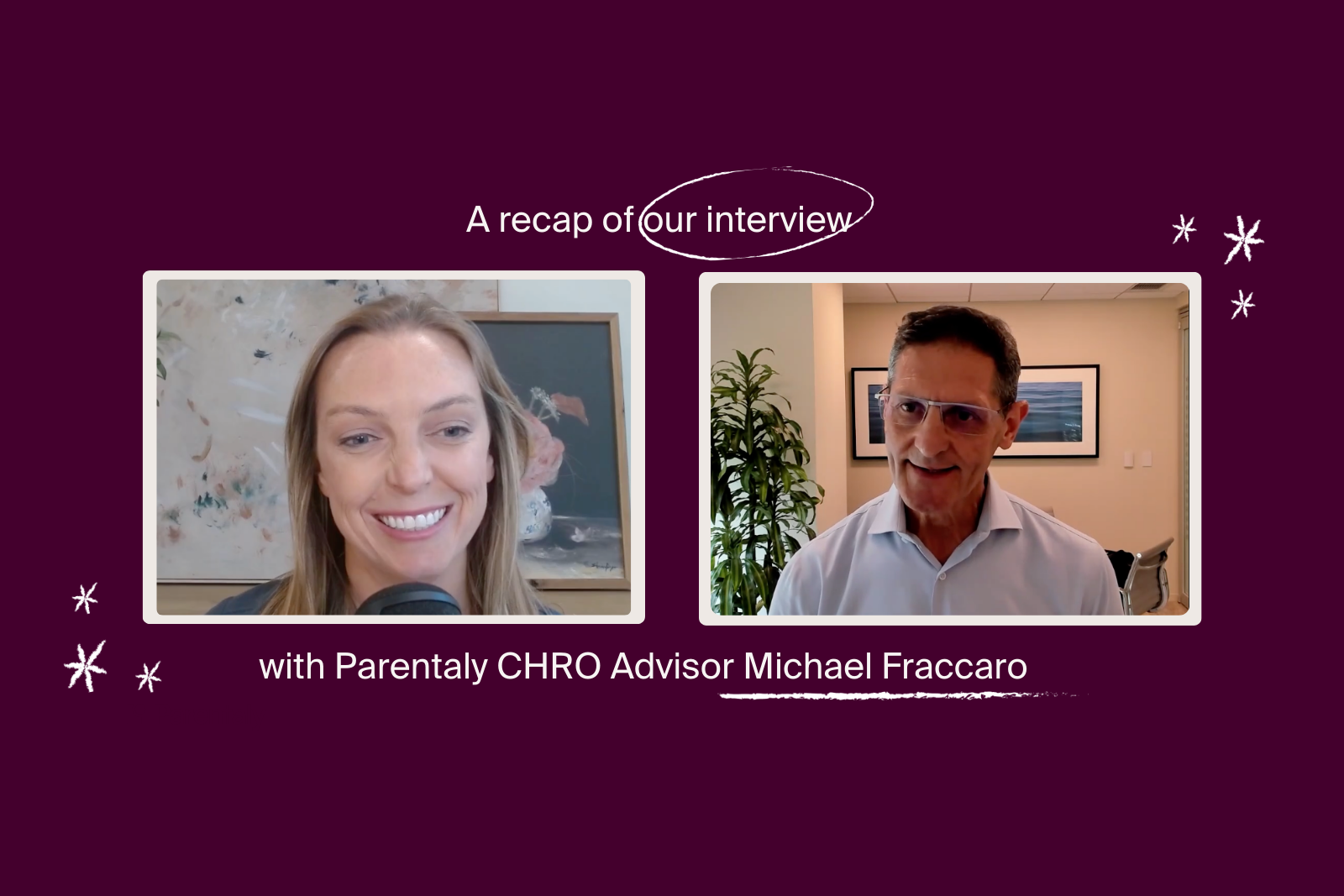

After leading the people function at Mastercard for 12+ years, former Chief People Officer Michael Fraccaro wasn’t sure what was next. He was newly retired, but wasn’t quite ready to fully step away from making an impact.
Then a few things happened at once: he became a grandfather for the first time, he watched his daughter navigate the realities of new parenthood and career, and then... he got a call from our CEO Allison Whalen.
Once he learned more about Parentaly’s mission, the value was clear. Michael saw how our programs solve a real business need - and help employees thrive during one of the most pivotal moments in their careers.
Michael became the first CHRO to join our advisory board, lending his time and expertise to help more companies take a strategic, business-minded approach to parental leave.
In today’s episode, Michael shares what drew him to our work, how he’s seen parental leave benefits evolve throughout his career, and why he believes support through leave transitions is business-critical.
He also opens up about what he’s learning from his own family - and why even a seasoned HR leader finds new perspective when watching his daughter become a parent.
Disclaimer: This podcast transcript is autogenerated and may contain minor errors or discrepancies.
Allison: Michael, thank you so much for joining me here today.
Michael: It's great to be with you, Allison. Good to see you.
Allison: I should say good to see you again. I would love to start with, we recently met just a couple months ago. I kind of found you at the best possible moment for me selfishly, which is you had just announced your retirement. You were transitioning out of Mastercard and continued to do so. And you're starting to think about what's next. You don't have to do anything at all, but you started talking to me, and you got really interested in what we were doing and you decided to join us as one of our first CHO advisors. Of all of the things that you could do in your world today, why did you even pick up the phone for me? Why, Parentaly, why is this interesting for you to spend your time on this?
Michael: Yeah, so yeah, as you said, it came at a really interesting time. I mean, when you make a decision about, you know, stepping down and moving on to the next stage of your life, you become quite reflective about what's important. And around about the same time as that decision was happening from a professional perspective, there was also a personal influence as well. And so our daughter just had, you know, her first child, our granddaughter,
And so it gave me an opportunity when I started speaking with you about the work that Parentaly is doing around she's professional our daughter Now having to go through this process about thinking about you know motherhood as well as a professional career and balancing the two and so That was really the sort of the catalyst of why I was drawn to Parentaly because I thought apart from
benefits that organizations offer like the parental leave and so forth, what other support is there? And so I became quite intrigued with this particular mission. And I do think the work that you're doing and Parentaly about reaching out to organizations and thinking about the support before going on parental leave and then after is such an important aspect that quite often we overlook.
And I thought that was really important. And now I've got a real, you know, lived experience that's happening right now. And yes, I've had my own children, you know, we've had our own kids and we've, that was a different generation and time. But this is something unique and different. And I really think there's a real great value proposition that Parentaly can offer. And that's what drew me to it.
Allison: And as you started to share with your network, with your coworkers at Mastercard, with folks in your life about Parentaly, what has been their feedback and has there been anything that you've learned that's surprising from them?
Michael: Yeah, so, you know, my, my user group or focus groups are probably two segments. One was around HR professionals that sort of looked at this and said, yeah, I can see the real value of providing this support both to the individual themselves that's just getting ready to go on parental leave, as well as the team or the manager of thinking through what to do and how to equip the team, when typically the mom is on leave for that period of time. So I think that was sort of one. So there's a professional aspect to it.
And even thinking about it from the point of view from a talent strategy, and again, from a professional point of view, we're always thinking about how do we retain our talent? How do we keep them motivated and engaged through that process, both of when they're leaving to go on the parental leave as well as not having that guilt of what are they going to do when they come back or if they come back, what is the role and what are they going to be doing? So there's an aspect there that we can go a lot deeper on. But then the other aspect is more the personal side as well, which is around the sense of loneliness about going through something like this. And yes, it's great to have 16 weeks of leave or 20 weeks of leave or whatever it may be.
But it's much more than that. It's really getting deeper into all of the emotional aspects and thinking about all of the questions that an individual is gonna have, particularly the first time around of being a mom or being a parent and trying not to have that sense of emptiness or guilt about those feelings are normal and natural and having the opportunity to speak ton individuals that have been through that journey before and that network I think is a really important step and I think that's again another aspect. And so when I spoke to just recently an individual within our team that's gone on parental leave for the second time round, I asked her, said, you know, what's it been like for you both the first time and the second time and would a service like this be helpful for you?
And it was unanimous. was absolutely, this would be fantastic because it would just allow me to be able to express myself and what I'm feeling and what I'm going through to someone that actually has that lived and shared experience. that's on a personal level and the professional side as well.
Allison: Yeah, and it's interesting you use a second time parent as an example, because I think sometimes people think once you are a parent, you're good. And actually there's a lot of research that shows that it's the second parental leave that is the most risky for the organization in terms of losing that person. Because the second time around, the person is not questioning their self as much. They feel confident, they're already a parent.
They know kind of some of the parenting things that are coming and their identity doesn't feel like it's being totally turned around. And so when things don't feel right, they start to focus on their job and their work and say, well, maybe that's the problem is that things have fallen apart here or this isn't set up right. And so it is a really interesting space, I think that we're in where oftentimes when you're a first time parent, there's a lot of identity crisis for lack of a better term that people need support with as well as of course the work piece. And then with the second and third time parents, so much of it is the work, right? And like, how do we set up our work and our careers to align with what we want to achieve?
Michael: Yeah, I just going to say, I mean, there is a sense of almost innocence the first time around, like this almost a naivety about, you know, I'm a career person, you know, and I'm going to be able to do this, I'm going to be able to do the child raising as well as continue to have a really strong and, you know, go back to the routine that I had before. And I think it's only when you get into
You know, after having the child that you start to realize actually all those things that I thought I was going to be able to do, there are some decisions and trade - offs and there is a moderation in terms of how you think about it. And so as you said, the second time around, you're probably a little bit more aware and in tune with how you're actually going to balance, you know, both and to ensure that you've got a support network. And so, you know, whether it'sit's the other parent or it's grandparents or it's friends. mean, even some of the simple decisions around, you know, do we take, in our case, our granddaughter to a childcare, you know, during the working hours or do we bring in a nanny?
And then there's the whole economics of that as well, that the couple has to decide how they're to manage and some of the health aspects as well. So there's a whole range of pieces and again quite often you're not necessarily prepared before but actually having someone that's been through it to be able to just tease through and say, the way have you thought about this and have you prepared? And even though it may not register immediately at that point, during those months or those weeks that you're away, things will start to trigger. And then it'll start to make sense and then you can start making better informed decisions about what works for you and your family.
Allison: Yeah, I'm curious if there have been other moments aside from your daughter becoming a mother, other moments in your life or career that stand out when you think about parental leave, whether this is a coworker that went on leave and said something and it left a big impression on you or other moments throughout your career that this became a really important topic for you.
Michael: Yeah, I mean, it does. And there's a couple of times, you know, in my professional career, both here at Mastercard, but in other organizations as well. And when I see, you know, individuals that are having to juggle both the professional career. So for example, the role that I've played, and I've worked in a couple of global companies, a lot of our roles require us to travel and to go abroad or to go interstate and so forth. And even that, thinking about one of my coworkers of having to think about how they're going to manage that aspect of having someone else looking after their kids while they're traveling, what routine that they need to have. So that's sort of one part.
The other aspect is around these jobs that many of us are in are fairly intense as well. And so being able to be there to feed the children or be there at dinner time or the wash up time, whatever it may be, and then being able to still give 100% to the job, it just gives me, it has given me a real sense of appreciation about how particularly working moms, have to think about those particular things. And I haven't necessarily stopped and paused and thought about, am I providing some undue pressure? Is there some expectation that I should have been more in tune of about how the individual has been feeling and dealing with doing the professional work, but also managing the day to day? And again, it comes back to...
You know, the work that Parentaly does is actually spending time with the manager and with the team to actually think about, as that as that individual is going away on parental leave or when they're coming back, just think about these other aspects. And I think it would help build a stronger bridge and actually help with productivity and build that stronger cohesion and empathy with each other. And so I think those pieces are really important for leaders to be aware of as well.
Allison: Yeah, it's funny as you were talking, I think I couldn't stop thinking about how so much of what we see is that problem that you've described and how oftentimes the solution is so small. It's so minor. The solution isn't usually, moms or dads or whatever don't travel. The solution is such a tiny tweak around just a little bit of flexibility that allows folks to maybe not take a full week trip, but maybe take four nights away instead of six nights away, or stay in a hotel that has a fridge for the breast milk storage. mean, they're really minor things that as a manager, it may never occur to you. And those are the types of things where I think we drive a lot of value because I do think that we're in this sort of, a lot of people are in dual income households where both parents are working, both parents care about their careers, and it's not necessarily like people want to downshift, if they want to, great, but is there a way for us to introduce just the tiniest bit of flexibility to support that, you know, the career results that everybody wants and that the company wants as well? You're exactly right.
And maybe this is a good segue into, I was gonna ask you, you've been at the helm of HR across a variety of organizations for many, many years. How have you seen the evolution of how companies support parents more broadly? Not just parental leave, but how would you describe that evolution from the head of HR, HR leadership position?
Michael: Yeah, it has, it's evolved a lot. mean, I think there are, there are some markets that we operate in, let's say in the Nordics or in parts of Europe, Australia, where I'm from, where, you know, there are mandatory, you know, maternity leave initiatives, right? So it's, it's regulated in many ways. In other markets, it's not so. And so it becomes more of a, you know, this is the right thing to do and acknowledgement and it is a critical part of, as I mentioned earlier, the talent strategy or the culture of the organization to acknowledge and to celebrate parents that are having children and doing all those wonderful things. It's a wonderful part of an organization. So you sort of see the spectrum, what you have to do because it's regulated and it's statutory. And the other side is around, this is something that's important as a talent value proposition as well, because we value our employees and we really want them to celebrate and to again, to acknowledge that this is a stage of their life that they're going through and we want to be there with them.
And I think that's the shift that I've seen and more so particularly for the more enlightened organizations that really do value their employees and trying to build a strong culture of really leaning in and providing that kind of support around them. The next step, however, is the proposition coming back to Parentaly, which is actually going another layer, another level. So I think for most organizations now, there's like the table stakes of a larger, a longer number of weeks of parental leave that's offered.
But the step that now needs to go forward is this coaching and this mentoring and this support, both for the individual and for the team and the manager. And I think that's sort of the next step. And I think that should become then the table stakes that every parent and every team that is going through this is to be much more intentional about what this is all about. And it's not just time off.
Michael: But it's also thinking through carefully and having a guide to help you, a more like a sherpa to guide you through something because for some it's like new territory. And yes, they're going to get stories from other colleagues that are going through it or have been through a similar journey, but actually having some professionals that are having an independent, you know, cohort or coach to go through that I think is a really important aspect. And I think that is sort of the next step of this change that we're seeing.
Allison: Why do you think that this parental leave support, obviously it's very good for the employee and they enjoy it, but why do you feel that it's business critical?
Michael: Well, a couple of things. One is around, if you look at the data points and if you can share your sort of research that you've done as part of the link to this podcast. I mean, you look at the retention rates, you look at productivity, turnover, all of those metrics are really important. So this becomes not just a nice to have, but a real commercial aspect. And I think when you start going deeper into organizations and you start to analyze, know, could we have done better in terms of retention or support or on the other side of the equation that if we're offering this kind of a benefit, are we able to attract talent as well into our organization? Those things actually have a value to the organization. And so, you know, when you're talking to a CHRO or to a CFO about what is the value proposition here of doing something like this? This should be able to pay itself back just by helping both on the culture side, but also in terms of some real raw data that actually can show some business benefit as well.
Allison: And this will almost sound repetitive, but I am curious how you would answer this question. And then I'm going to dive into the rapid fire questions. Why do you believe or how does parental leave tie into the future of work?
Michael: Ah, this is a great question. I mean, the future of work. Look, I think investing in parents, it's a critical part of our workforce. And this is like a win - win for the employee, for the company and society as a whole. We know that the cost of healthcare, we know the cost of living is extremely high and anything that we can do to create better value actually has better economics in the long run as well. And so I think this is such an important part of why something like this, a benefit like this really embedded into the organization and they think about their workforce strategy, this actually has a big benefit for everyone. So I think it's a real critical aspect for that.
Allison: Okay, I'm gonna jump into the rapid fire. Now, Michael, I'm sorry I did not preview these questions with you. So if you hate them, we'll edit them out afterwards. But I'm gonna ask you a couple of rapid fire questions just to get your very quick response in a couple of sentences. Some of these are not gonna be related to parental leave. So I'm basically taking advantage of the fact that I have this brilliant mind in front of me to ask you these questions.
First rapid fire question. You've had a front row seat to how the workforce has evolved. What is something that you saw early that others were a bit late to recognize or adopt?
Michael: That's a good one. I think, I think this whole piece around, you know, the evolving role that leaders have, that it's not just, it's not just about your formal authority, but also this moral authority. So to say it in other words, quite often we spend a lot of time in organizations thinking about all charts and who reports to who and so forth, but we lose sight of what's really important for individuals, which is purpose. And I love the saying, which is around you get better outcome from not requiring people to do something, but inspiring them to do something. And there are times where you have to sort of blend the two, but I think the greater level of engagement and followership is when people are doing things because they're inspired to do it. And so,
I think that's an important part and we've been doing a lot of work on our own leadership development, executive development to go down to that core and to really reimagine what the leaders of the future are all about. And I think we're doing a pretty good job. We're at the start of that, but it's a really great journey.
Allison: Great answer. What is the best leadership advice you've ever received?
Michael: to listen, to always listen and to often listen to not what's being said, but what's not being said. That has been a really great insight that I've taken from probably 20 years ago when I was working in Asia. I thought it was just a wonderful, wonderful way of thinking about the roles that we play in HR and that quite often we spend more time speaking and advocating for certain things, but actually quite often the best way to get solutions is just to listen and to absorb and to sometimes find out what's not being said because quite often the answer is there.
Allison: What is the biggest myth about HR that you wish would just go away?
Michael: I still hear from time to time, you know, about the seat at the table. And I think that is the biggest myth because most HR professionals that I work with and my peers and so forth, that is something that has gone away like 15, 20 years, but I still hear it from time to time. And I think it's just something that just needs to be completely blown up and eradicated, in my view.
Allison: Yeah. What's one trait that you would look for if you could only hire based on that trait?
Michael: I think it would just be this curiosity and agility that the roles that we play, and obviously now we see AI and workforce transformation. I think we are in a sort of you know, pilot seat navigating the changes that are happening as a result of this technological transformation. And the only way that you came to do it is because no one's got the playbook, no one's got all the answers, but to remain curious and agile and adapt, I think it's such an important aspect that helps in all walks of life. And so that would be the attributes.
Allison: Amazing. Okay. Last question and it's a pretty easy one. Policy or program that you were most proud to implement at Mastercard?
Michael: Well, think program wise, I would say the program that we've done is around the performance management. I spent a lot of time thinking about our culture and how we measure it. But the one big piece was around embedding the what and the how in performance management. And therefore there's an equal weighting on both what people do, but how they do it. And it's aligned to our behaviors, our Mastercard way, that's sort of one. And then the other one from a policy perspective, coming out of the pandemic, flexibility has been a big initiative. And even today, people will say, Michael, the best thing that you did was introduce work from elsewhere, which is basically, you know, four weeks a year where you can work from anywhere in the world, virtually anywhere.
Allison: That's so cool.
Michael: And so if I'm in Sydney and I'm there for work or I'm there for a holiday, I can extend for up to four weeks and work out of Sydney and still be with family, but not having to return. mean, those kinds of things are huge. And that flexibility again is a core ethos of the culture that we have here.
Allison: Goes such a long way and doesn't actually cost you anything. But it buys you a lot of loyalty and engagement from your employees. I just think that's amazing. Okay, Lide, I'm going to ask you one more question and end it on a fun note. What is on your retirement bucket list? What do you want to do that you've never been able to do before?
Michael: Well, a lot of travel. Yeah, we're to do a lot more travel and we're going to go to exotic places. Some places that my wife isn't too keen on like safaris and things like that. But a lot of those kinds of things and really being out there in nature because we've got the time. We've done a lot of the big cities before, but now it's like going into different areas like the national parks and some major hikes and so forth. So that's what we're looking forward to do. One thing on my list is to do the Kokoda Trail, which is in Papua New Guinea. And it's like a five day hike through the rainforests and it's an amazing trip and looking forward to doing that with a friend or a couple of friends. And maybe some of my kids as well will want to join as well. So that'll be good.
Allison: Your wife didn't sign up for that one?
Michael: She's not, no, she's gonna be based somewhere else.
Allison: Well, thank you so much for your time today. think anytime I get the chance to talk to you, I feel like I learn 20 new things. And I feel very honored that you are opting to spend just a tiny bit of your time in retirement with us because you don't need to do anything. You could ride off into the sunset or pop a New Guinea and never talk to anyone again. So thank you so much for sharing your thoughts and of course for being such a great source of support for all of us.
Michael: Thank you. And I really want to just appreciate everything that you do and the work and the mission of Parentaly. And you've got a great vision. And myself and the other advisors are just to continue to help advocate and help support and really amplify the messages in the work that you and your team do. So thank you.
Allison: Thank you.
Monthly updates on our newest resources, podcast episodes and must-know news and stories related to parental leave.
